

In Gorgeous Display, Ugochukwu Damian Okpara (Fordham University Press, September 2023)
“here / i am not his image / & i envy it / i shut my eyes against what is left / the crackling softness of life / like communion / desire is a marathon / a baton waiting for your grip / here / i am not running / neither is he / i sit with a man for the first time / & we talk about war . . .” – from “Beautiful Boy with Garlands around His Waist”
In Gorgeous Display, by Nigerian poet Ugochukwu Damian Okpara, is a volume dedicated to the memory of those lost to anti-queer violence in Nigeria and elsewhere. In this first full-length collection of his work, Okpara examines queer male identity, effeminacy, and exile, offering meditations on desire and sanctuary, freedom and estrangement. Forty-three poems pierce familial relationships, safety, fear, and anxiety portrayed through the outward sign of hand tremors, queer lynching, survival, hope, the emptiness of exile, and reclamation of the self. Embracing the ephemeral and spiritual nature of physical beauty, Okpara also reveals the scars of queer displacement, illuminating the ways that leaving home is never quite the utopia one hopes for and how often the ache of abandonment can haunt a life lived in the present.
“In Ugochukwu Okpara’s In Gorgeous Display we meet a son trying to reconcile a relationship with his father, his mother, his nation, and himself. Fighting against the erasures and violences of queer bodies in his native Nigeria, the poems found here are rife with searching, with discovery, with a quiet power that does not attempt to perform for the reader but rather seeks a reconciliation that is understood across oceans and cultures. Okpara unearths the way fissures shape and break us, move us and guide us, and ultimately push us towards a kind of healing that may not yet be named. This is a wise and graceful book that sits at the intersections of inter-generational time and space and serves as a suture of past and present.” – Matthew Shenoda, author of The Way of the Earth
.
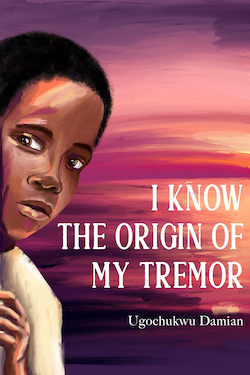
I Know the Origin of My Tremor, Ugochukwu Damian Okpara (Sundress Publications, 2021).
I Know the Origin of My Tremor was the winner of the 2020 Editor’s Choice Prize.
“I know what desire looks like for I’ve stood at its door for too long.” Ugochukwu Damian Okpara’s elegiac collection tugs at the nerves of our deepest yearnings. These poems explore the types and shades of loss that humankind can experience and the vibrant sorrow that loss can elicit. They dig through grief, the body, loneliness, longing, and gender dysphoria, making this collection unforgettable in its haunting vulnerability. Here, you will find a father’s ghost hovering, tremors earthquaking the page, and a narrator searching to untangle themselves from the in-between. A striking testament to survival, I Know the Origin of My Tremor reminds us how boldly a body can long for something.
“I Know the Origin of My Tremor tries again and again to be a collection of queer joy, but joy is not often found in a world that wishes you dead. So, you learn to hide the body of desire, to dig a hole and bury it deep. After all, as Damian writes, ‘Fear is the language that saves us.’”
–Lannie Stabile, author of Good Morning to Everyone Except Men Who Name Their Dogs Zeus
“In I Know the Origin of My Tremor, Ugochukwu Damian weaves the personal and universal into a world at once both familiar and strange. Trains of images arrive in Orphic strains that will haunt and elevate the reader. As one poem puts it, “Amnesia fails me yet again.” This collection makes the line come true: You will rejoice at remembering how ‘joy falls like freshwater,’ and that desire really can ‘dance like fire.’ To rephrase this terrifically talented poet, grief and forgetting have nothing on these poems.”
–Jake Sheff, author of Looting Versailles and A Kiss to Betray the Universe
“With his nimble voice and stylistic curiosity, Ugochukwu Damian lingers on the thresholds of mind, memory and physical experience in this volume. Orbiting the often haunted questions of where and what a home should be, these poems map out a true interiority for genderqueer living in the Nigerian public. Still, the palpable dream of joy is to be found both within—this body, this self, this life—and without. Here is a gifted young poet who recognises that ‘sometimes healing can be invasive’; a poet who invites such invasion—even approaches it—with admirable courage and candor.”
–Logan February, author of In The Nude
 UGOCHUKWU DAMIAN OKPARA, writer & poet